Last updated June 30, 2026
Seasonal Garage Door Care for Orlando: Year-Round Homeowner’s Guide
Most Orlando homeowners assume that skipping seasonal garage door maintenance is a reasonable trade-off for living somewhere without ice storms or frozen ground. That assumption is wrong — and it’s one of the most consistent patterns we see after 22 years servicing garage doors across Orange County. Orlando’s climate doesn’t let your door off easy; it just attacks it differently. Heat, humidity, hurricane-force wind loads, and the occasional sharp cold snap create four distinct stress cycles every year, and a door that survives all four without attention is doing it on borrowed time. This guide walks through exactly what to check, when to check it, and what to watch for in each cycle — so you can stay ahead of the failures before they strand you in your driveway.
Quick Answer
Orlando garage doors don’t face winter ice, but they face sustained heat above 90°F, hurricane-season wind loads, corrosive humidity, and sharp cold snaps that all stress springs, cables, and hardware in different ways. Two hours of inspection and maintenance spread across four seasonal checkpoints — roughly March, June, October, and December — prevents the majority of service calls and extends the working life of your door system by years. The single most important task across all four cycles is a combined lubrication and balance check, which takes about 20 minutes and catches developing problems before they become emergency repairs.
Table of Contents
- Spring (March–May): Pre-Heat-Season Hardware Inspection
- Summer (June–September): Hurricane Prep and Wind-Load Readiness
- Fall (October–November): Post-Storm Assessment and Hidden Fatigue
- Winter (December–February): Cold Snaps and the Spring Tension Surprise
- The 20-Minute Lubrication and Balance Check (All Four Cycles)
- Common Mistakes to Avoid
- When to Call a Professional
- Frequently Asked Questions
Spring (March–May): Pre-Heat-Season Hardware Inspection
The window between late March and mid-May is the single most valuable maintenance period for Orlando homeowners, and most people miss it entirely. By the time June arrives, temperatures in Orange County are regularly pushing 92–96°F by early afternoon, and that sustained heat causes metal components — particularly torsion springs, roller stems, and cable drum brackets — to expand. When those components are already at the edge of their tolerance due to accumulated wear or insufficient lubrication, the expansion tips them into failure.
What you’re looking for in a spring inspection isn’t dramatic damage. It’s the early indicators: slight rust bloom on spring coils (especially in homes near Lake Nona or any of the communities east of the 417, where morning ground fog is common), stiff movement through the door’s upper travel range, or a door that sits noticeably uneven at the halfway-open position. These are pre-failure signals, not post-failure discoveries.
Spring Inspection Checklist
- Torsion springs: Look for rust, gaps in the coiling, or any visible separation. A spring showing rust streaks along more than one-third of its length is living on borrowed time in an Orlando summer.
- Rollers: Spin each roller by hand if accessible. Any roller that grinds, wobbles, or has a visibly worn nylon wheel needs replacement before heat compounds the wear.
- Cable drums and end bearings: Check for fraying at the cable-to-drum connection point. In humid climates, this junction corrodes faster than the cable body itself.
- Bottom seal: Florida’s spring insect pressure (particularly palmetto bugs and fire ants entering from expansion joints) is controlled almost entirely by a good bottom seal. Cracked or compressed seals invite both pests and the afternoon downpours that start in late May.
- Opener sensitivity settings: Heat affects motor performance. Retest the auto-reverse force sensitivity on your opener before summer loads arrive.
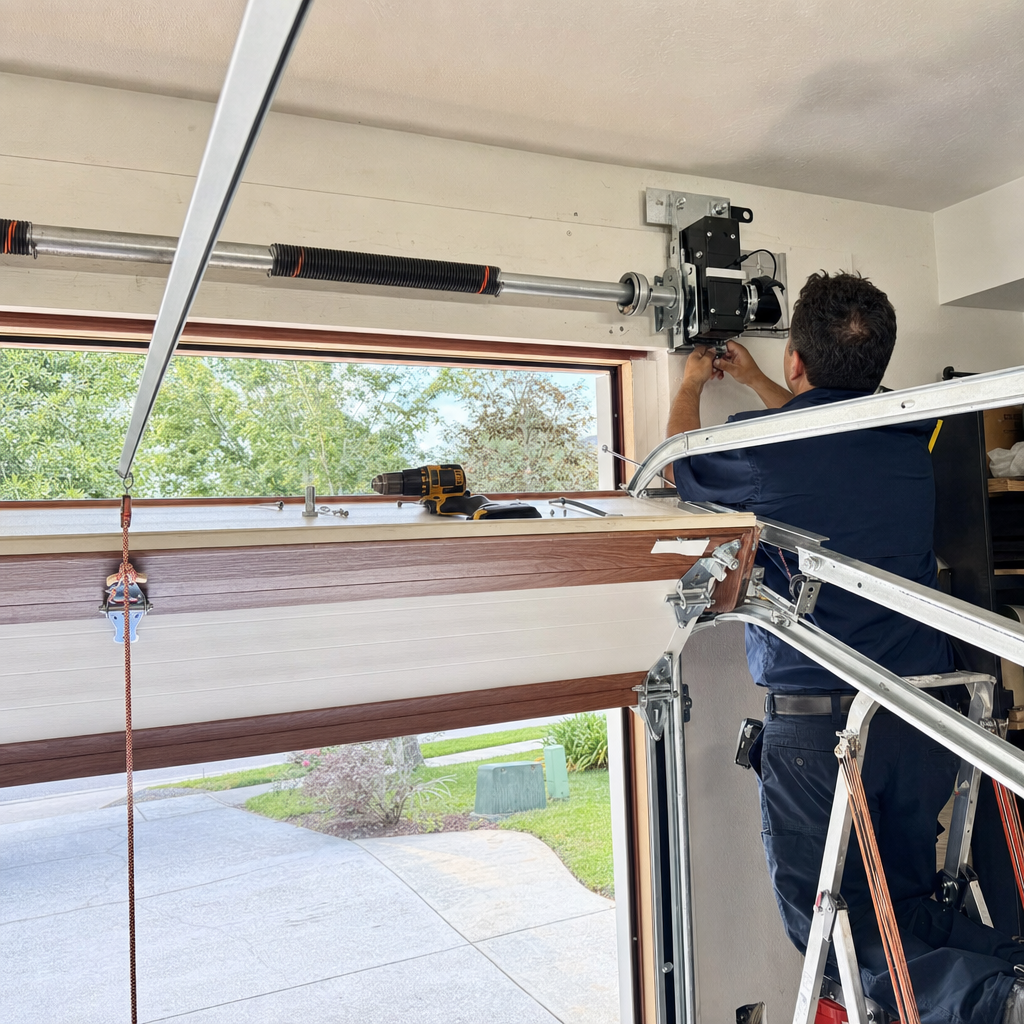
Important: Torsion springs are under several hundred pounds of stored tension. Visual inspection from a safe distance is appropriate for homeowners; adjusting, replacing, or servicing springs is strictly professional work. A spring that lets go without warning can cause serious injury. If you see anything concerning, call a trained technician rather than attempting a repair.
Summer (June–September): Hurricane Prep and Wind-Load Readiness
Orlando isn’t on the coast, but that doesn’t mean hurricane season is irrelevant here. Central Florida regularly sees tropical storm conditions and wind gusts from 60 to 90 mph during named storms — Hurricane Ian in 2022 produced sustained winds across Orange County that caused widespread panel damage and cable failures on standard residential doors. Your garage door is typically the largest and most wind-vulnerable opening on your home, and a door that fails under wind load creates a pressure differential that can lead to roof damage.
“Wind-rated” is a term that gets used loosely in home improvement conversations, but it has a specific meaning: a door tested to Florida Building Code wind-load requirements, typically with horizontal bracing struts and reinforced end stiles. If your home was built before 2002, when the Florida Building Code was substantially strengthened post-Andrew, there’s a reasonable chance your door doesn’t meet current wind standards — and upgrading to a current Clopay or Amarr panel with proper strut reinforcement is both a safety and insurance-related decision worth discussing with a professional.
Pre-Hurricane Season Checklist
- Verify your brace kit: If your door has a horizontal brace strut system, confirm each strut is securely bolted to the door sections — screws back out over time from vibration.
- Check the bottom seal for full perimeter contact: Storm water infiltration under a failed seal causes significant floor and threshold damage. Replace any seal that shows light gaps when the door is closed.
- Test your emergency disconnect: The red cord hanging from your opener trolley should disengage the door cleanly. You may need to operate the door manually during a power outage; knowing the disconnect works before a storm is not optional.
- Review your opener’s battery backup: LiftMaster and Chamberlain both offer battery backup units that keep the door operational through outages. If you don’t have one, summer before storm season is the right time to install it.
- Secure external keypads and accessories: High winds can damage surface-mounted keypads on brick or stucco facades — check mounting screws and weatherstripping around any surface hardware.
Fall (October–November): Post-Storm Assessment and Hidden Spring Fatigue
October is the most underrated maintenance month in Orlando. Storm season ends, temperatures drop into the 70s, and most homeowners assume the door made it through without incident. But here’s what we consistently see in post-season service calls: a door that operated through June, July, August, and September — under heat, repeated manual disconnects during outages, and wind-load events — often has accumulated fatigue damage that isn’t visible and doesn’t yet produce a failure. It produces the next failure, usually in February or March.
The fall assessment is specifically about finding that hidden stress. You’re not just looking for current problems; you’re looking for components that storm season has pushed close to their service limit.
Post-Storm Assessment Protocol
- Cable inspection: Run your eyes along the full cable length under normal tension. Look for individual broken wires — they look like small wire bristles standing away from the cable body. One or two broken wires is a warning; a cluster means the cable should be replaced before winter.
- Spring cycle count estimation: Most residential torsion springs are rated for 10,000 cycles. If your spring hasn’t been replaced in 7 or more years and the door cycles multiple times daily, you’re in the replacement window — post-storm fatigue compounds this.
- Panel alignment check: Wind loading can shift panel alignment subtly. Close the door fully and check the gap consistency along the top and sides. Uneven gaps indicate that panels have shifted or the track has moved.
- Weatherstripping along the sides and top: Florida’s storm season puts UV and wind stress on this material. Cracked side seals allow the cold-air infiltration that becomes more relevant from November through February.
- Opener chain or belt tension: Repeated manual operation during power outages can slightly alter drive tension. A chain that’s developed significant sag is putting additional stress on the trolley carriage.
Winter (December–February): Cold Snaps and the Spring Tension Surprise
This is the section that surprises most Orlando homeowners. Florida has winter, and while it’s not Minnesota, the Central Florida region sees multiple nights each winter where temperatures drop to 38–45°F, and occasionally below freezing in areas like Christmas, Bithlo, and the eastern rural sections of Orange County. Those temperature drops don’t just make mornings uncomfortable — they change the physical behavior of garage door springs in a way that causes a disproportionate number of service calls.
Torsion springs are made of steel, and steel contracts in cold. A spring that’s been set to the correct tension at 80°F is slightly over-tensioned at 40°F, meaning it’s working harder every cycle during a cold snap. If that spring already has wear from the summer and storm season, the cold snap is often what tips it to failure. We see this pattern consistently in January and February — the door worked fine all summer, survived the storms, and then snaps a spring on the first genuinely cold morning of the year, when the opener is already working against contracted, tight metal.
Winter Maintenance Focus Areas
- Lubrication with temperature-appropriate grease: Standard white lithium grease performs well year-round in Orlando’s climate. Avoid WD-40 on springs and hinges — it’s a solvent, not a lubricant, and it strips the existing grease film.
- Check opener’s heating element if applicable: Some Genie and Craftsman units in climate-sensitive areas include heating elements in the motor head. Verify yours is functional before the first cold front.
- Test door balance in cooler morning temperatures: If you have a choice, do your balance check on a morning when it’s below 55°F. Imbalance shows up more clearly in cold because the motor is working against both gravity and contracted springs simultaneously.
- Inspect the bottom rubber seal for cold brittleness: Rubber compounds that seemed flexible in October can become stiff and crack-prone in January. A brittle seal that cracks under the door weight creates an air gap that affects conditioned space adjacent to the garage.
The 20-Minute Lubrication and Balance Check (All Four Cycles)
This is the single maintenance task that overlaps all four seasonal periods, and skipping it consistently is the most expensive maintenance mistake Orlando homeowners make. A door that’s properly lubricated and in balance puts less stress on every other component — the opener motor, the torsion spring, the rollers, and the cables — during every cycle. A door that’s out of balance by even a few pounds shifts all that extra load onto the weakest component in the chain, and that component fails first.
The entire process takes about 20 minutes and requires one can of garage door lubricant spray (not WD-40 — a product specifically formulated for garage door hardware, such as the 3-in-1 garage door lubricant available at most hardware stores).
20-Minute Lubrication and Balance Check — Step by Step
- Disconnect the opener. Pull the emergency release cord so the door operates manually. This step is essential — you need to feel the door’s true balance without the opener masking it.
- Lubricate the torsion spring. Apply lubricant along the full coil length, rotating the spring slowly to get even coverage on the inner coil surfaces. This takes 60–90 seconds per spring.
- Lubricate every hinge pivot point. There are typically 10–12 hinges on a standard two-car door. Apply a short burst to each pivot, then cycle the door manually twice to work it in.
- Lubricate the roller stems (not the roller itself). The stem — the shaft that passes through the hinge bracket — gets the lubricant. Getting grease on the nylon wheel of a nylon roller reduces traction in the track and causes skipping.
- Lubricate the top rail and trolley (chain or screw drive openers only). Belt drives don’t need rail lubrication. For chain drives, apply lubricant along the chain, then run the opener through a full cycle.
- Perform the balance test. With the door disconnected from the opener, lift it manually to waist height (about 3–4 feet) and let go. A balanced door stays put or drifts slowly. A door that falls or rockets upward is out of balance — that’s a professional adjustment, not a DIY fix, because spring tension adjustment involves real risk of injury.
- Reconnect the opener and test auto-reverse. Place a 2×4 flat on the floor under the door, close it, and confirm the door reverses when it hits the board. If it doesn’t reverse cleanly, the sensitivity adjustment needs recalibration — consult your opener manual or call a technician.
Common Mistakes to Avoid
- Using WD-40 as a garage door lubricant. WD-40 is a water displacement solvent, not a lasting lubricant. Applied to springs or hinges, it temporarily reduces friction, then evaporates and leaves components drier than before. In Orlando’s heat, it evaporates fast — use a product specifically rated for garage door hardware.
- Skipping the post-hurricane-season inspection because the door “seems fine.” Hidden cable fatigue and shifted panel alignment don’t cause immediate failures — they cause failures three months later, in winter, when the service calendar is already full. A door that operated through storm season still needs a fall check.
- Assuming a wind-rated door needs no reinforcement hardware. A wind-rated panel without its strut kit properly installed is no longer wind-rated. We regularly find doors in Orlando’s newer subdivisions — including communities in the South Orange and Dr. Phillips corridors — where struts were delivered with the door but never bolted into position by the builder crew.
- Ignoring a door that operates but sounds wrong. Grinding, squealing, or rhythmic clunking on every cycle are pre-failure sounds, not quirks to live with. In 22 years working on garage doors in Orlando, the pattern is consistent: the homeowner mentions they’d been hearing something for weeks before the spring snapped or the cable let go.
- Adjusting spring tension as a DIY project. Torsion springs store enough energy to cause broken bones or worse when they release unexpectedly. This is the one garage door task where the risk level doesn’t match a DIY approach regardless of mechanical aptitude. Every other inspection item on this page is homeowner-appropriate; spring adjustment and replacement are not.
- Letting the bottom seal go another season. In Orlando’s climate, a compromised bottom seal allows moisture, insects, and conditioned air to move freely. Replacing a $30–$60 bottom seal every 3–4 years prevents water damage, pest entry, and energy loss that costs significantly more over time.
- Assuming all opener brands work the same way. A LiftMaster 8500W wall-mount unit and a Craftsman belt drive have different adjustment, sensitivity, and battery backup procedures. Using the wrong manual or the wrong approach when adjusting limit settings can damage the opener. Know your brand, or call someone who knows all of them.
When to Call a Professional
Some garage door maintenance is genuinely homeowner-appropriate. Lubrication, visual inspections, seal replacement, and balance testing all fall in that category. But several situations require a trained technician, and recognizing them early saves both money and risk.
Call a professional when you see any of the following:
- A torsion or extension spring that is broken, visibly cracked, or showing a gap in the coils — springs under load are dangerous and should only be replaced by a technician with the correct tools and training
- A cable that has come off the drum, is visibly fraying, or has a kink — cable repair while the door is under spring tension carries the same risks as spring work
- A door that fails the balance test (falls or rises sharply when manually released at mid-height)
- Panel sections that are buckled, cracked, or significantly out of alignment after a storm event
- An opener that runs but doesn’t move the door, or that reverses without obstruction
- Any situation where the door won’t close and you can’t visually identify a clear, safe explanation
Shield Garage Door Solutions Orange County offers free estimates in Orlando — call (689) 400-8360 and Paul will assess the situation directly, without a service fee just to look at it.
Frequently Asked Questions
Lubricate your garage door hardware every three months in Orlando — more frequently than the national recommendation of twice yearly. Orlando’s heat and humidity accelerate lubricant breakdown, particularly on spring coils and hinge pivots that see daily temperature swings of 20–30°F between morning and afternoon. A quarterly schedule aligns naturally with the four seasonal checkpoints described in this guide and keeps components in consistent condition year-round.
Yes — and it catches people off guard every January. When temperatures in Orange County drop to the upper 30s or low 40s, steel torsion springs contract and effectively over-tension, putting extra stress on every cycle. Springs that are already at the tail end of their service life frequently fail during or right after a cold snap. This is one of the busiest service periods of the year for Orlando garage door technicians, and the calls almost always start with “I don’t understand — it worked fine all summer.” The fall inspection is the best preventive measure against this specific failure pattern.
A wind-rated garage door in Florida has been tested to withstand specific wind-pressure loads without structural failure — the door won’t buckle inward or blow out under the pressure differential a hurricane or strong tropical storm creates. The rating requires both the door panels themselves (with reinforcing struts) and the mounting hardware to meet Florida Building Code standards. A door is only as wind-rated as its fully installed configuration — panels without struts, or struts without proper end bracket attachment, don’t meet the standard. If your home was built before 2002, a current Clopay or Amarr wind-rated panel is worth evaluating for both safety and insurance purposes. Call (689) 400-8360 for a free assessment.
Standard residential torsion springs are rated for approximately 10,000 cycles — roughly 7–10 years for a home that cycles the door four times daily. In Orlando, heat and humidity can compress that timeline, particularly if the spring isn’t lubricated quarterly. Springs on doors that went through active hurricane seasons with multiple manual disconnect operations tend to show fatigue on the earlier end of that range. If your spring is more than seven years old and hasn’t been inspected since installation, a fall assessment is worth scheduling before winter.
Yes — bottom seal replacement is one of the genuinely DIY-appropriate garage door tasks. Most residential doors use a T-slot retainer system; the old seal slides out of the aluminum channel at the bottom of the door, and the new seal slides in. The job requires a flathead screwdriver, a rubber mallet, and about 30 minutes. Choose a replacement seal rated for Orlando’s heat and UV exposure, as some lower-cost rubber compounds go brittle within a season in direct Central Florida sun. If the retainer channel itself is damaged or missing, that’s a professional repair.
Garage door openers in good working condition can often be repaired — circuit boards, drive gears, and trolley assemblies are replaceable components on most LiftMaster, Chamberlain, Genie, and Craftsman units. Replacement makes more sense when the unit is more than 12–15 years old and parts are no longer available, when it lacks modern safety features like auto-reverse and photoelectric sensors, or when the cost of the repair approaches 60% or more of a new unit’s price. Paul can assess your specific opener and give you a straight answer on repair versus replace — call (689) 400-8360 for a free estimate in Orlando.
The Bottom Line
Orlando garage doors don’t get a seasonal break — they cycle through heat stress, hurricane wind loads, post-storm fatigue, and cold-snap tension changes every single year. The homeowners who avoid emergency service calls aren’t doing anything complicated; they’re running through a focused inspection at each of those four transition points and doing a 20-minute lubrication and balance check every three months. That’s roughly two hours of attention per year. In our experience working on garage doors across Orange County for over two decades, the doors that fail dramatically are almost always the ones that were ignored quietly for years. The ones that keep running reliably are the ones that got a little consistent attention each season.
If anything in this guide has you looking at your door differently, that’s the right reaction. A quick inspection costs nothing. A snapped spring on a Monday morning — when you’re already late — costs considerably more than it would have in October. If you want an experienced set of eyes on your door before the next stress season arrives, call us. Garage Door Repair in Conway and throughout Orange County — we’ll tell you exactly what we find, and we won’t recommend work that doesn’t need doing.
For a free estimate anywhere in Orlando and surrounding Orange County communities, call (689) 400-8360. Paul picks up — or calls back the same day.
If you’re also considering a new door or opener, our Garage Door Installation in Conway and Garage Door Opener in Conway pages cover what those decisions involve in practical terms.
Written by Paul Johnson, Owner & Lead Technician at Shield Garage Door Solutions Orange County, serving Orlando since 2004.